 See photos and updates from listings directly in your feed
 Share your favorite listings with friends and family
 Save your search and get new listings directly in your mailbox before everybody else
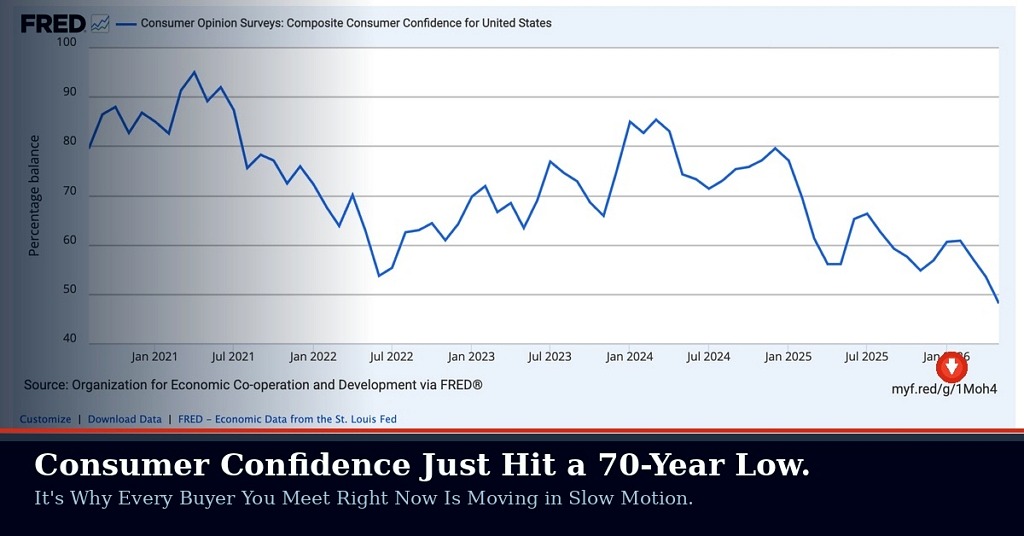
Every month we’re flooded with housing statistics. We hear about inventory levels, mortgage rates, median home prices, and days on market. Those numbers are important, but they don’t always explain why buyers are behaving the way they are.
There is another chart I think every buyer and seller should see before looking at any real estate data. It isn’t a housing chart at all. It’s the OECD Composite Consumer Confidence Index, published through the Federal Reserve’s FRED database. The index measures how Americans feel about the economy, their personal finances, job security, and whether they believe it’s a good time to make major purchases.
Economists have followed this index for decades because confidence often changes before consumer behavior does. When people feel optimistic about the future, they’re generally more willing to make significant financial commitments. When uncertainty begins to grow, they naturally become more cautious.
Today, consumer confidence sits near one of the lowest levels recorded in modern history.
That doesn’t automatically mean a recession is imminent, nor does it suggest that home prices are about to collapse. What it does explain is something every real estate professional—and many homeowners—have been noticing over the past year.
Buyers simply aren’t behaving the way they did three or four years ago.
It’s Not Just About Mortgage Rates
For months, nearly every conversation about housing has centered on interest rates. Mortgage rates certainly influence affordability, but they don’t explain everything we’re seeing in today’s market.
If rates were the only factor, buyers would simply calculate their monthly payment, determine whether it fit their budget, and make a decision. Instead, today’s buyers are taking more time. They’re viewing additional properties before making an offer, requesting more inspections, negotiating more carefully, and often stepping away from their search for several weeks before returning.
Those behaviors aren’t driven solely by financing costs. They’re driven by uncertainty.
When people feel uncertain about the future, they naturally become more cautious about making one of the largest financial commitments of their lives. Purchasing a home—particularly a retirement home, second home, or luxury property—isn’t simply a financial decision. It’s also an emotional one. Buyers want confidence that they’re making the right decision, not just today, but five or ten years from now.
The Consumer Confidence Index helps explain why today’s buyers are approaching that decision much more deliberately than they did during the highly competitive markets of 2021 and 2022.
Why Hilton Head and Bluffton Are Different
Our market differs from many parts of the country because much of our demand is driven by lifestyle rather than necessity.
In cities with large employment centers, many buyers relocate because a new job, promotion, or family circumstance requires them to move regardless of market conditions. Hilton Head and Bluffton are different. Many of our buyers are purchasing a retirement home, relocating for a better quality of life, buying a second home, or investing in a market they believe will continue to perform well over time.
Those are discretionary decisions.
When consumer confidence declines, discretionary purchases are often the first to slow—not because buyers no longer want them, but because they want greater certainty before committing. They’re waiting for inflation to stabilize, interest rates to become more predictable, or the broader economy to feel less uncertain.
Demand doesn’t disappear.
The pace of decision-making simply changes.
Today’s Buyers Are Looking Beyond the Home
One of the biggest differences I’ve noticed over the past year is the type of questions buyers are asking.
Three years ago, many buyers walked into a home and immediately imagined themselves living there. Today’s buyers certainly care about finishes, floor plans, and location, but they’re also evaluating the long-term strength of the investment.
They want to know whether the neighborhood will remain desirable. They consider future resale potential, insurance costs, maintenance expenses, and how the property might perform if economic conditions remain uncertain for several years.
Those aren’t signs of fearful buyers.
They’re signs of thoughtful buyers.
In many ways, today’s buyers are conducting exactly the kind of due diligence we often wished buyers had exercised during the fast-moving markets of 2021 and 2022.
The Fundamentals Haven’t Changed
One of the biggest mistakes investors make is allowing short-term emotions to outweigh long-term fundamentals.
The reasons people choose Hilton Head and Bluffton remain remarkably consistent. People continue to retire here. Families relocate to enjoy a better quality of life. Remote work has allowed more professionals to choose where they live rather than where they work. Our beaches haven’t changed, our golf courses remain among the best in the country, and developable land along the coast continues to be limited.
Those factors helped build this market long before today’s economic uncertainty, and they’ll likely continue to support it long after consumer confidence improves.
Confidence influences the speed of the market far more often than it changes the long-term desirability of exceptional real estate.
What This Means for Sellers
For sellers, today’s market rewards preparation, presentation, and realistic pricing more than ever before.
Well-maintained homes that are priced appropriately continue to attract qualified buyers. Properties that enter the market based on pricing expectations from two or three years ago often spend considerably more time waiting for offers.
That doesn’t necessarily mean the home lacks value. More often, it reflects the fact that today’s buyers are evaluating purchases through a much more cautious lens.
The sellers who understand this shift and position their homes for today’s market are generally the ones achieving the best results.
What This Means for Buyers
If you’ve found yourself moving more slowly than you expected, you’re certainly not alone.
Consumer confidence suggests millions of Americans are approaching major financial decisions with the same level of caution. Ironically, that caution may also be creating some of the best buying opportunities we’ve seen in years.
With fewer buyers competing for the same homes, many purchasers have greater negotiating leverage, more time for inspections and due diligence, and more opportunities to compare properties before making a final decision.
History has shown that confidence typically improves after economic conditions begin to stabilize. When that happens, more buyers return to the market simultaneously, competition increases, and many of today’s advantages begin to disappear.
Waiting for confidence to fully return often means buying in a more competitive environment.
My Perspective
After more than twenty years helping clients buy and sell homes in several states and a few countries, I’ve learned that housing markets are driven as much by psychology as they are by economics.
Home prices, inventory, and mortgage rates all matter. But confidence often determines whether someone chooses to act today or wait until tomorrow.
The buyers I’m working with haven’t lost interest in owning property in the Lowcountry. They’re simply taking more time to make sure they’re making the right decision. Given today’s economic backdrop, that’s a perfectly rational response.
The Lowcountry continues to offer an exceptional lifestyle, limited coastal inventory, and enduring long-term appeal that has attracted buyers for generations. Those fundamentals remain intact.
Consumer confidence will recover eventually.
Until it does, understanding why buyers are behaving differently may be one of the most valuable pieces of market knowledge a buyer or seller can have.